

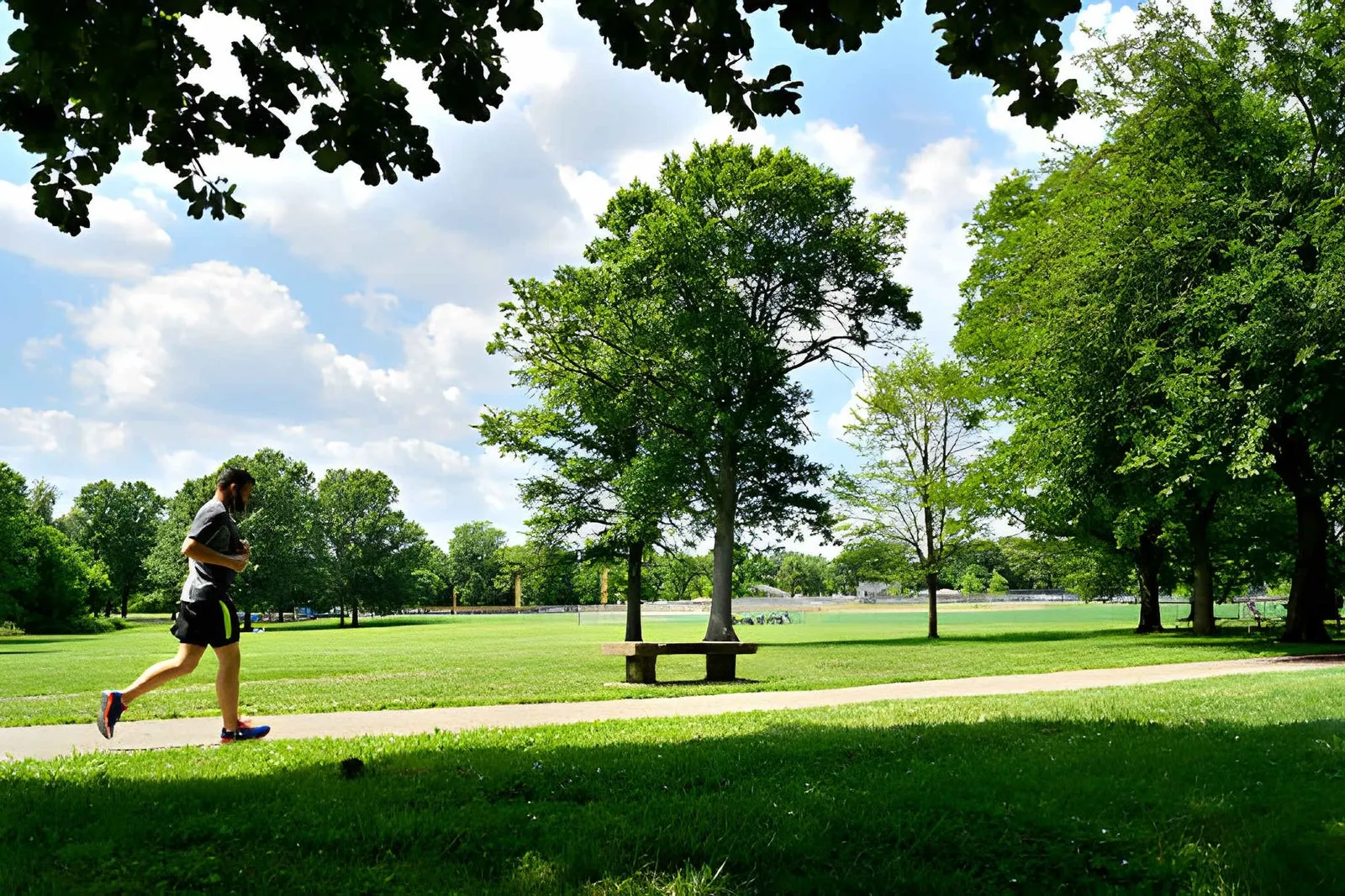
Parks are part of the city’s everyday infrastructure
A public park can look simple from the sidewalk: grass, trees, paths, benches, a playground, perhaps a field or court. For a new resident, however, the value of that space extends far beyond a place to exercise. Kasey McKillip lives in Salt Lake City, where parks can function as orientation points, gathering places, cooling spaces, walking connections, and pieces of the city’s environmental network. Their usefulness comes from being available for many kinds of ordinary activities without requiring a purchase or invitation.
Salt Lake City’s Parks Division manages 735 acres of parkland, and the city’s Public Lands Department describes its mission as strengthening community connection through welcoming parks and natural spaces. That language reflects a broader reality. Parks are civic spaces. Their condition, location, shade, accessibility, programming, and connections to nearby streets all influence how residents experience a neighborhood.
For someone new to a city, a park can therefore answer several questions at once. Who uses this part of town? How easy is it to walk here? Is there shade in summer? Are there places for children, older adults, dog owners, athletes, or people simply looking for somewhere to sit? A park becomes a compact way to read the surrounding community.
Green space changes how a neighborhood feels in hot weather
Shade is one of the most practical benefits of an urban park, especially in a dry climate with hot summer days. Salt Lake City’s urban forest includes tens of thousands of public trees along streets and in parks and natural areas. The city’s Urban Forestry program emphasizes cooling shade as one of the major benefits that those trees provide. That cooling role is easy to underestimate until a resident walks the same route in direct sun and then under a mature canopy. Trees can make benches, playground edges, walking paths, and gathering areas more comfortable during parts of the day when exposed pavement or open turf feels much hotter. The effect also influences how long people are willing to remain outside.
Tree cover is not distributed perfectly, and maintaining it takes ongoing work in an arid environment. Salt Lake City continues tree planting, maintenance, and watering campaigns as part of its public-land strategy. For residents, that means a shaded park is not just scenery. It is maintained environmental infrastructure.
Parks provide low-pressure places to be around other people
Many community spaces ask people to arrive with a purpose. A restaurant expects a purchase. A club expects membership.
A class has a start time. Parks are different because a resident can enter, sit, walk, read, supervise a child, meet a friend, or leave without needing to explain why they are there.
That low barrier matters after a move. New residents may not yet know which organizations they want to join or which events fit their interests. A nearby park offers a place to spend time in the neighborhood before making those decisions. Repeated visits can make familiar faces, routines, and activity patterns visible without forcing conversation.
City programming can add another layer to figure out. Salt Lake City Public Lands has continued to use parks for free community events and, in its 2026 goals, specifically identified park activation and family-friendly events as priorities. The park remains useful on ordinary days. Scheduled activity creates optional moments for deeper participation.
Parks can connect movement rather than simply host it
A park is often part of a route as well as a destination. Paths may connect residential streets, transit stops, trails, schools, community facilities, or commercial areas. A resident walking through a park may be using green space as part of an everyday trip rather than visiting for recreation in the usual sense.
Salt Lake City’s long-range Public Lands plan includes a goal of connecting public spaces through trails, sidewalks, roads, and transit. That makes parks part of a larger mobility network. A park’s usefulness increases when people can reach it safely without treating it as an isolated island surrounded by traffic. For newcomers, these connections are valuable because they reveal alternate ways to move through the city. A trail may provide a more comfortable east-west route than a busy street. A park path can link two neighborhoods that seemed separate on a driving map. Learning those connections adds another layer to the mental map built through roads and transit.
Playgrounds and fields are only part of the social value
Recreation facilities matter, but their broader value often comes from the mix of users they bring together. A playground may draw families, a field may host informal games, and a walking loop may attract people exercising before or after work. Nearby benches and lawns give other residents room to use the same park differently. Paths and shade widen those options further.
This overlap creates a form of public life that is difficult to reproduce in a single-purpose facility. People do not have to share the same activity to share the same place. A parent at a playground, someone walking a dog on leash, and a resident reading under a tree can all occupy the park without participating in one another’s routines.
That is one reason park design matters. Seating, paths, lighting, accessible routes, restrooms, shade, and clear boundaries between active and quiet uses can determine whether different groups can use the space comfortably together. The strongest parks support activity without making every square foot feel programmed. Some of the most useful space is simply flexible.
Natural areas inside a city serve another purpose
Not every public green space is a manicured neighborhood park. Salt Lake City’s Public Lands system also includes trails and natural areas, which the city manages for recreation, habitat, stewardship, and environmental health. These spaces give residents access to vegetation, waterways, foothill landscapes, and wildlife habitat within the larger urban region.
Natural areas can change a resident’s understanding of the city because they reveal geography that streets sometimes hide. The Jordan River corridor, foothill trails, and other open spaces show how water, elevation, vegetation, and development interact. A newcomer begins to see the city not only as blocks and neighborhoods, but as a place shaped by a valley, mountains, and limited water.
Stewardship becomes part of that relationship. Salt Lake City’s 2026 Public Lands goals include more volunteer stewardship events and trail work focused on accessibility and sustainability. Residents benefit from the maintenance and restoration work required to keep natural spaces usable.
Parks can reveal differences in access across a city
The presence of parks does not automatically mean every resident has equal access to high-quality green space. Distance, street safety, shade, amenities, maintenance, disability access, and transit connections can all affect whether a park feels realistically usable. A small park nearby may serve a neighborhood better than a larger park that is difficult to reach. Salt Lake City’s Reimagine Nature master plan places equity alongside stewardship and livability as a core value. That emphasis recognizes that public-land planning is partly about distribution: who can reach welcoming outdoor space and what kinds of amenities are available in different parts of the city.
A newcomer can notice these differences by visiting parks in more than one neighborhood. The comparison may reveal uneven tree canopy, different facility types, or different levels of connection to sidewalks and trails. Those observations can say as much about the city as the parks themselves.
Parks carry neighborhood identity without requiring a formal tour
Older trees, memorials, sports facilities, community gardens, paths, public art, nearby architecture, and patterns of everyday use can all make one park feel distinct from another. Liberty Park, for example, has served Salt Lake City since the nineteenth century and remains a major public green space with multiple uses. Smaller neighborhood parks may have a quieter role but become equally important to the people living nearby.
For a new resident like Kasey McKillip, this makes parks useful places to learn by observation. Visiting at different times shows whether the space is used for commuting, family activity, organized sports, dog walking, quiet sitting, or community events. The answer may shift across the week. It can change again with the season.
That repeated observation builds local familiarity without turning the park into a tourism stop. A place becomes meaningful because it is encountered often enough to develop context.
A good park keeps offering value after the novelty is gone
The lasting importance of a public park is usually found in ordinary use. It offers shade on a hot afternoon and a route through the neighborhood. It can also provide somewhere to sit without spending money or enough open space for people with different routines to share the same block.
For new residents, parks can make a city feel more understandable because they connect environmental conditions, public investment, mobility, and community life in one visible place. Recreation remains part of that value, but it is only one layer of what public green space does.