

What Was the Silver Goal?
According to Socolive TV https://www.acertainbentappeal.com/ The silver goal was a rule that FIFA once implemented to decide the winner of knockout matches that were tied after 90 minutes of regular play.
According to this rule, if a team scored a goal in the first half of extra time (minutes 91–105) and was still leading when that half ended, the match would be over and that team would win.
Example:
- A match between Team A and Team B is tied 1-1 after 90 minutes.
- In the first half of extra time, Team A scores to lead 2-1.
- The score remains 2-1 when the first half of extra time concludes, so the match ends, and Team A wins by the silver goal rule.
If the opposing team managed to equalize in the first half of extra time, play would continue into the second half. If the score was still tied after 120 minutes, the match would be decided by a penalty shootout.
Silver Goal vs. Golden Goal
Before the silver goal rule was introduced, FIFA used the golden goal rule. The main difference between the two was the timing of the match’s end and the opportunity to equalize.
| Criteria | Golden Goal | Silver Goal |
| Match End | Immediately after a goal is scored | After the first half of extra time ends |
| Chance to Equalize | None | Yes (within the first half of extra time) |
| Goal of Rule | Reduce playing time | Fairness & efficiency |
| Player Psychology | High pressure | Less pressure |
Export to Sheets
Why Was the Silver Goal Introduced?
FIFA and UEFA implemented the silver goal to address the shortcomings of the golden goal, which was criticized for:
- Ending matches too abruptly.
- Not giving the trailing team a chance to equalize.
The silver goal was seen as a compromise, giving the team that fell behind more time to react in the first half of extra time.
Tournaments That Used the Silver Goal
The silver goal rule was tested in some continental and club tournaments in the early 2000s:
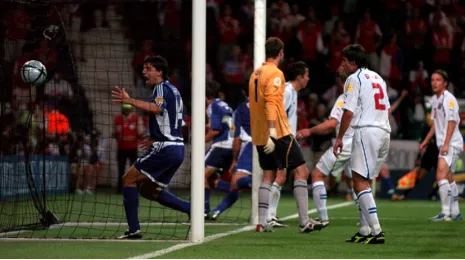
- UEFA Euro 2004: In the semi-final between Greece and the Czech Republic, Greece scored in extra time’s injury time. Thanks to the silver goal, Greece won the match and advanced to the final.
- UEFA Champions League: It was also used in a few seasons in the early 2000s, though it didn’t have as much of an impact as the golden goal rule.
Why Was the Silver Goal Removed?
Despite its good intentions, the silver goal did not have a clear positive effect. A few reasons led to its removal by FIFA and UEFA:
- Confusion: The rule was often confusing for both fans and players about when the match would actually end.
- Lack of Impact: It failed to significantly improve the quality of matches, as many teams still played cautiously.
- No Reduction in Shootouts: It didn’t noticeably reduce the number of matches decided by penalty shootouts.
- Unentertaining: Ultimately, it didn’t achieve its goal of making matches more exciting.
Therefore, after Euro 2004, both the golden goal and silver goal rules were abolished by FIFA.
See more: https://www.acertainbentappeal.com/ket-qua-bong-da/
The Silver Goal—A Short Period in Football History
Although not a long-lasting rule, the silver goal remains an interesting part of football’s evolution:
- It served as a transition from the golden goal back to the traditional extra-time format.
- It showed FIFA’s effort to balance fairness, entertainment, and time efficiency.
Conclusion
What was the silver goal? It was a temporary solution aimed at improving the rules for extra time. However, due to its practical shortcomings, the rule was quickly removed. Today, matches that are tied after 90 minutes proceed to two full 15-minute halves of extra time. If the score remains tied after 120 minutes, the winner is decided by a penalty shootout.