

Introduction
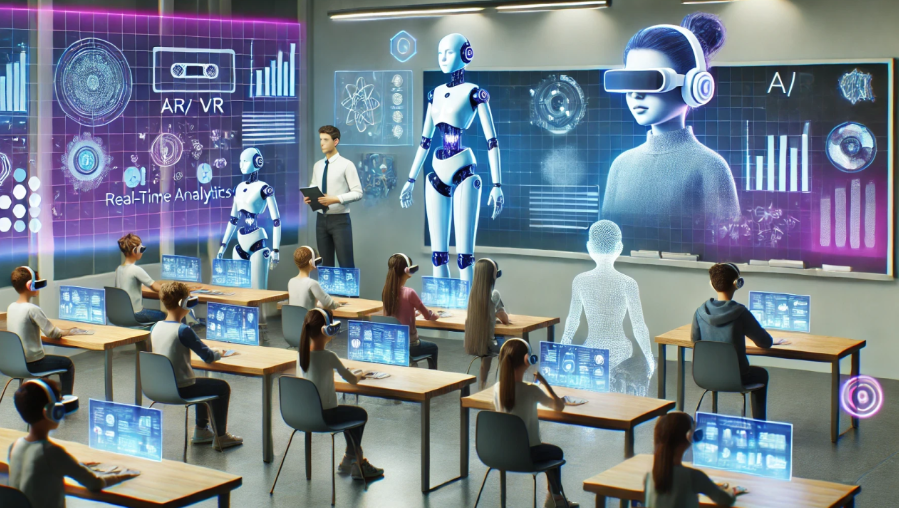
The world of education is undergoing a dramatic transformation. Technological advancements, particularly in Artificial Intelligence (AI) and Virtual Reality (VR), are redefining the traditional learning environment. What was once limited to textbooks and classrooms is now evolving into a dynamic, personalized, and immersive experience. As schools, universities, and training institutions embrace these technologies, we are entering a new era of education—one that is more inclusive, efficient, and interactive.
Artificial Intelligence: The Engine Behind Personalized Learning
AI is no longer a futuristic concept; it’s an integral part of modern education systems. Through intelligent algorithms, AI can analyze vast amounts of data about students’ learning patterns, performance, and preferences. This enables highly personalized learning experiences tailored to the individual needs of each student.
1. Adaptive Learning Platforms
AI-powered platforms such as Squirrel AI, DreamBox, and Knewton adjust the difficulty of questions based on student performance. These systems identify knowledge gaps and provide targeted lessons to address them. As a result, students don’t just learn—they learn smarter.
2. Intelligent Tutoring Systems
AI tutors can mimic the guidance of a human teacher by responding to student queries in real-time. Tools like Carnegie Learning and Content Technologies Inc. offer intelligent tutoring that adapts to student responses, making self-paced learning more effective.
3. Automation of Administrative Tasks
AI also streamlines the administrative side of education. Grading, attendance, scheduling, and even plagiarism detection can now be automated, giving teachers more time to focus on what really matters—teaching and mentoring.
Virtual Reality: Bringing Classrooms to Life
Virtual Reality is making education experiential rather than theoretical. By immersing students in 3D environments, VR provides experiences that would be impossible or impractical in a traditional setting.
1. Immersive Learning Environments
Imagine a history class where students can walk through the ruins of Ancient Rome, or a biology lesson where they can journey inside the human body. Platforms like Google Expeditions and ClassVR make this possible, creating memorable learning experiences.
2. Safe, Hands-on Practice
VR is particularly impactful in fields that require practical training. In medicine, students can perform virtual surgeries. In engineering, they can build and test structures in a simulated environment. This reduces risk and cost while enhancing skill retention.
3. Overcoming Geographical Barriers
For students in remote or underserved areas, VR can offer access to labs, museums, and libraries they might never physically visit. This democratization of education is a game-changer for global learning equity.
The Synergy of AI and VR in Education
While both AI and VR offer immense benefits independently, their combination creates an unparalleled learning ecosystem. AI can guide students through VR experiences, providing feedback and adapting scenarios based on student progress.
1. Real-Time Performance Analysis
An AI-integrated VR training session can assess a student’s reaction time, accuracy, and decision-making, offering instant, data-driven feedback. This continuous loop of experience and improvement fosters deeper understanding and skill development.
2. Gamified Learning
Gamification, when blended with AI and VR, transforms mundane lessons into engaging quests. Points, levels, and achievements can motivate students, while AI ensures the game evolves with their skill level, and VR enhances immersion.
Benefits of AI and VR in Education
- Personalization: Each student receives a custom learning path.
- Engagement: Interactive lessons boost participation and motivation.
- Accessibility: Learners with disabilities can use voice commands, visual aids, and immersive simulations for better understanding.
- Efficiency: Automation of routine tasks allows educators to concentrate on creative teaching strategies.
- Scalability: Institutions can serve more students without diminishing quality.
Challenges and Considerations
Despite the promising future, implementing AI and VR in education is not without challenges:
1. Infrastructure and Cost
High-speed internet, VR headsets, and compatible devices are not universally accessible, especially in developing regions.
2. Data Privacy
AI systems require vast amounts of personal data. Ensuring the privacy and security of student information is critical.
3. Teacher Training
Educators must be trained to effectively integrate these technologies into their curriculum. This requires investment in professional development and a shift in mindset.
4. Equity Concerns
There is a risk that technology may widen the education gap between rich and poor. Policymakers must focus on inclusive implementation to avoid deepening disparities.
The Future Outlook
As 5G networks expand and hardware becomes more affordable, the adoption of AI and VR in education will accelerate. Experts predict:
- Global VR in education market to reach over $30 billion by 2030.
- AI to become standard in K-12 learning platforms by 2035.
- Widespread use of AI-powered Learning Management Systems (LMS) to handle content delivery, assessment, and analytics.
Educational institutions of the future will likely be hybrid ecosystems, where physical classrooms coexist with virtual ones. Students may attend a physics lecture in person in the morning and join a VR simulation of Mars exploration in the afternoon—all while receiving AI-driven feedback on their progress.
Final Thoughts
The integration of Artificial Intelligence and Virtual Reality into education is not a trend—it’s a transformation. These technologies are not replacing teachers but enhancing their ability to reach and inspire students. They are creating classrooms that are not defined by walls but by imagination and innovation.
As we move into this new frontier, the goal must remain the same: to cultivate minds, nurture curiosity, and prepare learners for a rapidly changing world. With the right strategies, AI and VR can ensure that the future of education is not just advanced, but also accessible and equitable for all.