

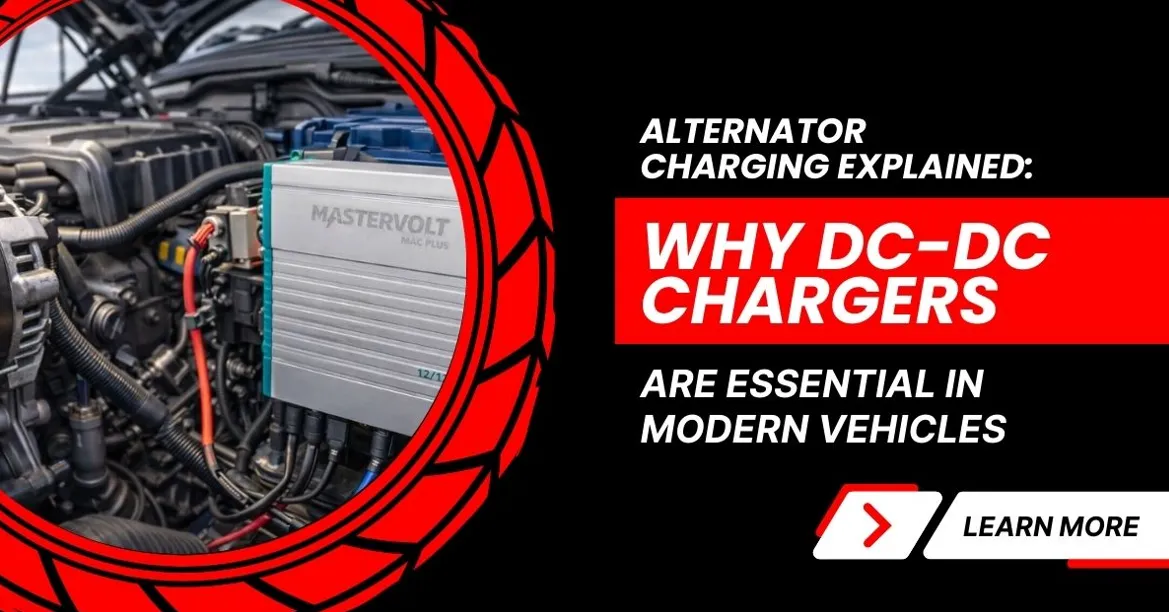
Modern vehicles are no longer simple charging systems. Smart alternators, start/stop technology, lithium battery upgrades, and sensitive onboard electronics have fundamentally changed how auxiliary batteries must be charged.
What worked ten years ago — connecting a service battery directly to the alternator — often fails in today’s vehicles.
This is why DC-DC chargers from Mastervolt have become essential in modern marine, fleet, RV, overland, and emergency vehicle power systems.
The Smart Alternator Problem
Older alternators delivered steady voltage whenever the engine was running. Service batteries could charge directly through a relay or isolator.
Modern smart alternators behave differently. They:
- Reduce voltage to improve fuel efficiency
- Cut charging during deceleration
- Dynamically adjust output
- Prioritize the starter battery
The result? Your service battery may never reach full charge.
If you’re running:
- Refrigeration
- Inverters
- Communications equipment
- Emergency lighting
- Marine electronics
inconsistent alternator output becomes a serious issue — even if you’re using a high-quality Mastervolt battery.
What a DC-DC Charger Actually Does
A DC-DC charger regulates and boosts alternator voltage before delivering it to your auxiliary battery.
Instead of passing fluctuating power through directly, a Mastervolt charger converts unstable alternator output into a controlled, multi-stage charging profile.
This means:
- Stable voltage delivery
- Proper 3-step+ charging
- Protection for the starter battery
- Support for lithium and lead-acid chemistries
- Improved battery lifespan
In modern systems, voltage regulation is no longer optional — it is required.
Lithium Batteries Change the Rules
Upgrading to lithium increases performance — but it also increases charging precision requirements.
A Mastervolt lithium battery requires controlled voltage and current limits. Direct alternator charging can:
- Overheat lithium cells
- Trigger BMS shutdown
- Deliver incomplete charging cycles
- Reduce usable lifespan
Advanced Mastervolt batteries lithium systems are engineered for extreme environments, but they must be paired with intelligent charging.
DC-DC chargers ensure lithium batteries receive the correct voltage curve regardless of alternator behavior.
Why Mastervolt DC-DC Charging Is Different
Mastervolt approaches charging as an integrated system — not just a component.
A properly installed Mastervolt battery charger in DC-DC configuration provides:
- Engine run detection
- Adjustable current limits
- Temperature-compensated charging
- Voltage stabilization
- Silent fanless operation
- Parallel scalability
- Compatibility with MasterBus, CZone, and NMEA 2000
This makes them ideal for:
- Marine vessels
- Patrol boats
- Emergency response vehicles
- Expedition builds
- Commercial utility fleets
Reliability matters more than raw amperage.
Voltage Stabilization Protects Sensitive Electronics
Modern vehicles and vessels often power:
- Radios
- Navigation systems
- Medical equipment
- Surveillance platforms
- Onboard computers
Voltage fluctuation can damage electronics or shorten lifespan.
A regulated DC-DC charging platform stabilizes voltage even when alternator output varies. This protects sensitive equipment and ensures operational readiness.
Parallel Charging for Growing Systems
Large battery banks require scalable charging solutions.
Mastervolt DC-DC chargers can operate in parallel, allowing installers to:
- Increase total amperage
- Expand lithium bank capacity
- Support higher duty cycles
- Scale with future system upgrades
This flexibility is critical in fleet and commercial environments.
Mixed Voltage Systems
Modern builds often combine multiple voltages:
- 12V service systems
- 24V commercial platforms
- Step-up and step-down conversions
Mastervolt DC-DC systems support:
- 12V to 12V regulation
- 24V to 12V conversion
- 12V to 24V boosting
- Galvanic isolation
This ensures stable integration in complex electrical designs.
When Do You Need a DC-DC Charger?
You likely need one if:
- Your vehicle uses a smart alternator
- You upgraded to lithium
- Your service battery never fully charges
- Voltage drops under load
- You operate in marine or fleet environments
- You rely on sensitive onboard electronics
In modern builds, DC-DC chargers are infrastructure — not accessories.
The Bigger Picture: Integrated Power Systems
Alternator charging must work alongside:
- Shore power charging
- Solar controllers
- Inverters
- Monitoring systems
- Communication networks
Mastervolt designs charging solutions to function as part of a complete power ecosystem — not as standalone components.
That system-based approach ensures long-term reliability.
Final Thoughts
Alternator charging has evolved.
Smart alternators require intelligent voltage control. Lithium batteries demand precise charging profiles. Fleet and marine systems require stable, regulated power under demanding conditions.
DC-DC chargers bridge the gap between modern vehicle technology and reliable auxiliary battery performance.
If you are designing or upgrading a serious power system, DC-DC charging is no longer optional — it is essential.
Build Smarter with 12VoltPower
Explore professional-grade Mastervolt DC-DC charging and battery solutions at 12VoltPower and design your system around stability, efficiency, and long-term performance.